The Stone City That Shouldn’t Exist: Nan Madol’s Engineering Mystery
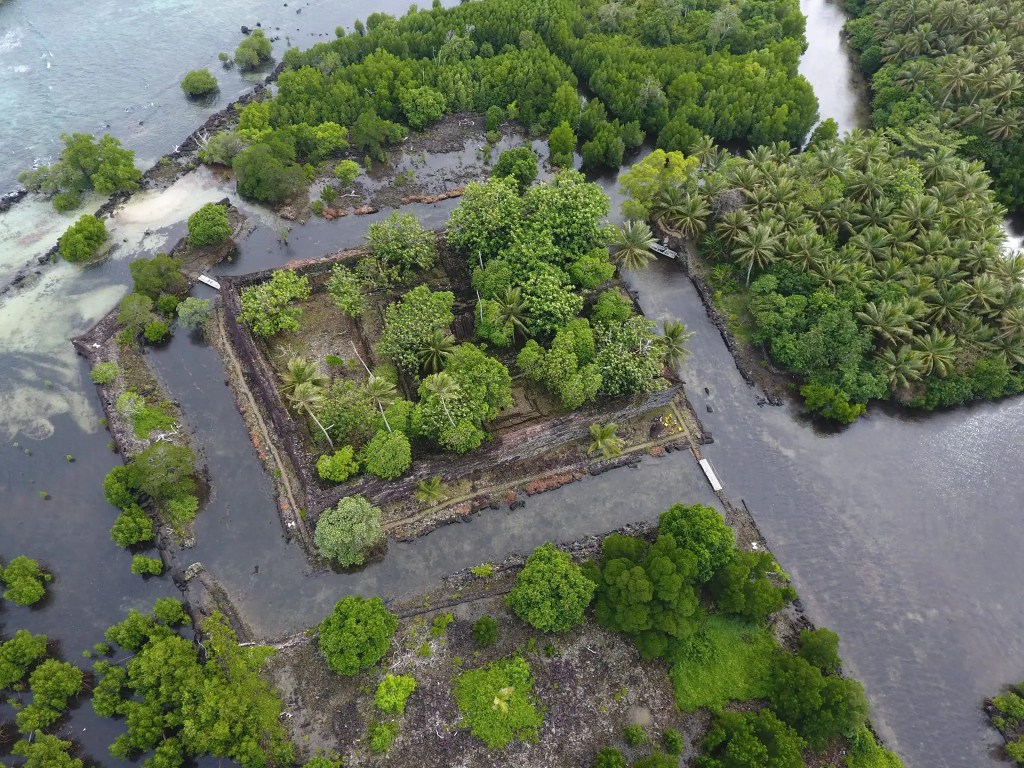
The morning tide rushes through the canals, and suddenly you understand why the locals won’t come here after dark. Ninety-two artificial islands rise from the coral reef, their walls built from basalt columns stacked like colossal Lincoln Logs. Each stone weighs as much as a loaded truck, yet they balance perfectly without mortar, creating a ghost city that has defied the Pacific Ocean for eight centuries. This is Nan Madol, where logic ends and legend begins—a place so impossible that oral tradition credits its construction to flying sorcerers, because how else could anyone explain it?
Quick Facts
- Built: 1180-1450 CE
- Architect(s): Unknown (attributed to sorcerers Olisihpa and Olosohpa)
- Commissioned by: The Saudeleur Dynasty rulers
- Materials: Basalt prisms, coral fill
- Dimensions: 1.5 km × 0.5 km (92 artificial islets)
- Status today: UNESCO World Heritage Site (2016)
The Sorcerer Kings: Power Through Isolation
The Saudeleur Dynasty didn’t just build a capital—they built a statement. Around 1180 CE, these rulers of Pohnpei decided that governing from the main island wasn’t enough. They needed separation, elevation, intimidation. The solution? Construct an entire city on the shallow coral reef off the eastern shore, accessible only by boat, where the ruling class could literally look down on their subjects from walls of stone.
According to Pohnpeian oral history, the first Saudeleur was born from the union of a native woman and a thunder god. But the real founders, say the legends, were two sorcerer-brothers: Olisihpa and Olosohpa. These mysterious figures supposedly arrived from the west, possessing the magical ability to make massive basalt prisms fly through the air from the quarries of Sokehs on the opposite side of Pohnpei. When skeptics point out that basalt doesn’t fly, traditionalists shrug—then how else do you explain 50-ton stones balanced on a coral reef?
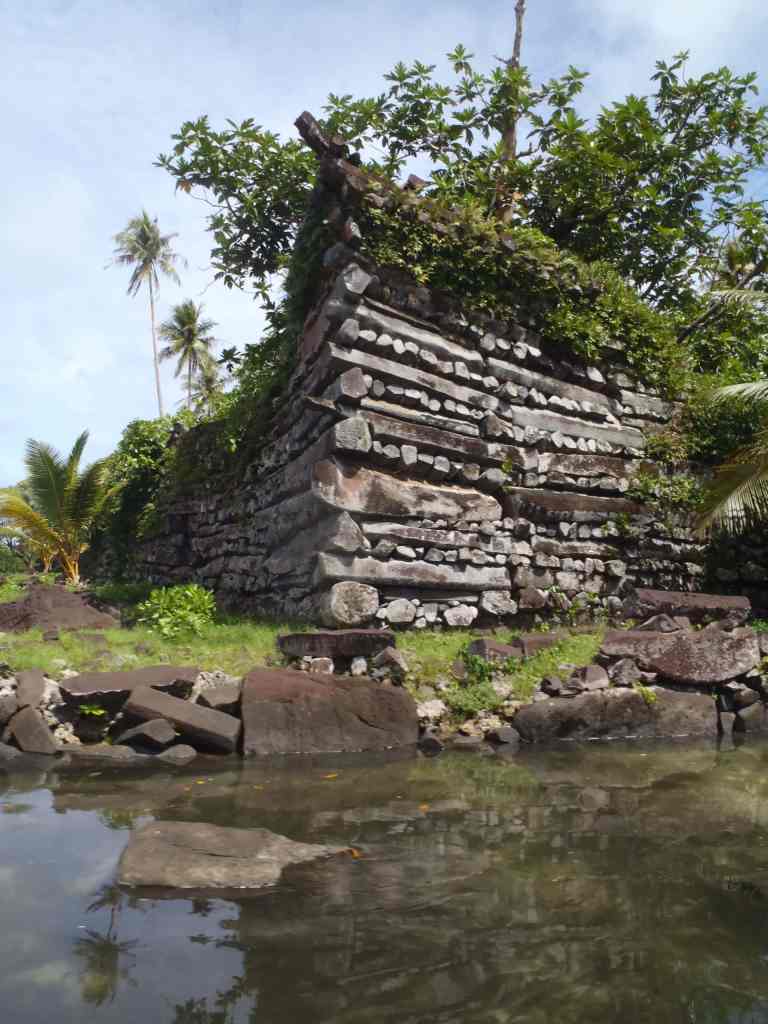
The name “Saudeleur” itself means “Lord of Deleur,” referring to the ancient name of Pohnpei. These were not benevolent rulers. The dynasty maintained power through a combination of religious authority and architectural intimidation. By building their ceremonial center on artificial islands, they created a physical manifestation of divine separation. Common people could see the stone city rising from the waves, but they couldn’t enter without permission. It was psychological warfare through urban planning.
Common people could see the stone city rising from the waves, but couldn’t enter.
Engineering the Impossible: Basalt as Building Blocks
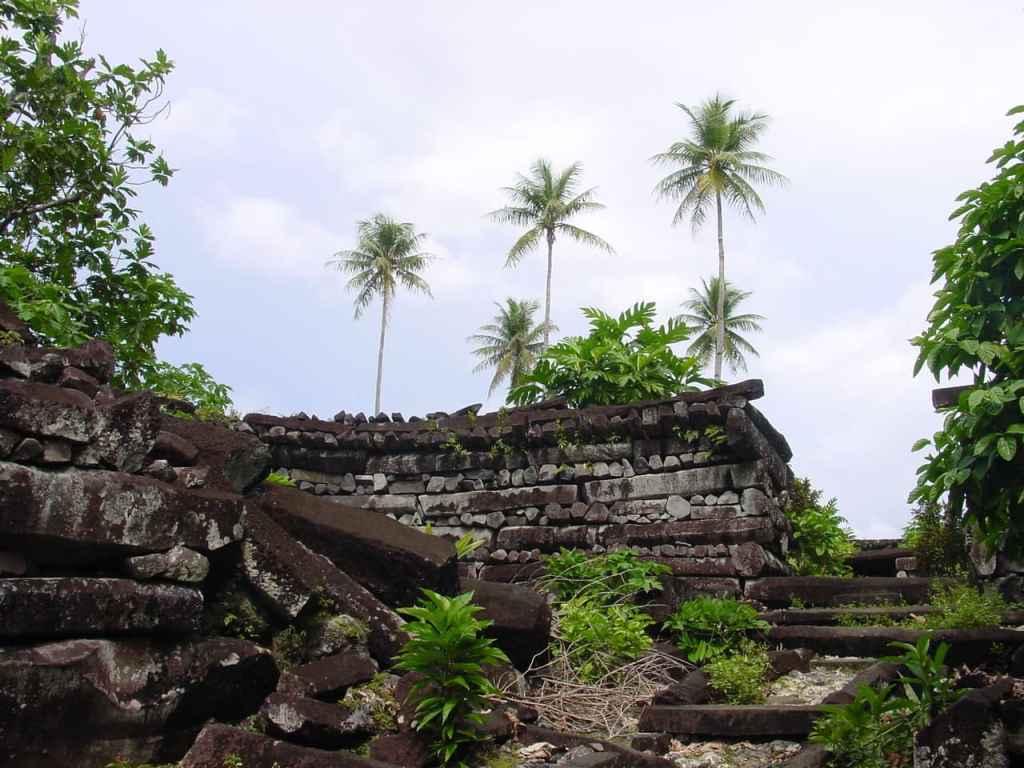
Nan Madol’s construction exploits a geological gift: columnar basalt. When basaltic lava cools slowly, it naturally fractures into hexagonal prisms—nature’s own prefabricated building material. The builders of Nan Madol recognized that these prisms could be stacked horizontally like logs, creating walls through friction and gravity alone. No mortar, no metal tools, no written plans—just an intuitive understanding of how stone wants to balance.
The largest structure, Nandauwas, serves as the royal mortuary complex. Its walls rise 7.5 meters (25 feet) high, built from basalt prisms that interlock in an alternating pattern. The basalt columns interlock through alternating orientation rather than precision-cut joints — their stability comes from mass, friction, and gravity rather than knife-tight masonry. The precision is breathtaking—gaps between stones are so tight that you can’t slip a knife blade between them.
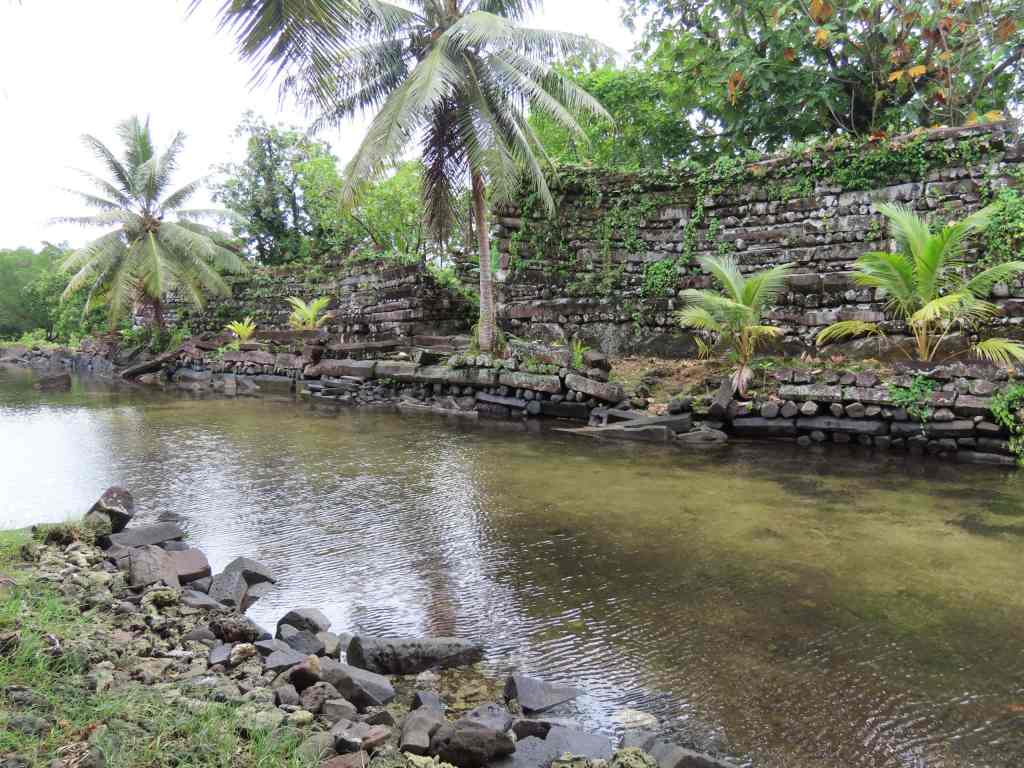
But here’s the mystery that keeps archaeologists awake at night: the basalt was quarried at Sokehs Rock on the opposite side of Pohnpei, across 25 kilometers of mountainous terrain and open ocean. How do you transport a 50-ton stone column by sea using only outrigger canoes? Modern experiments with smaller stones have failed spectacularly. The most plausible theory involves massive rafts made from bamboo or coconut fiber, towed by fleets of canoes during perfect weather windows. But even this strains credibility when you consider that Nan Madol contains an estimated 250 million kilograms of basalt.
By the Numbers
The average basalt column at Nan Madol weighs 5-10 tons. The largest single stone weighs an estimated 50 tons. Moving just one would require 1,000 people pulling in perfect synchronization.
Venice Meets Atlantis: Life in the Floating City
Nan Madol earned its nickname “Venice of the Pacific” honestly. The city’s 92 artificial islets are separated by canals that flood and drain with the tides. During high tide, outrigger canoes could navigate between the islands, delivering food, fresh water, and building materials. During low tide, the exposed coral reef became highways for foot traffic. This tidal transportation system wasn’t accidental—it was engineered.

Each islet had a specific function. Pahnwi housed the priests and religious ceremonies. Dapahu contained the royal residence. Peinering stored food supplies. The islands were connected by a hierarchy of access—commoners could reach the outer islets for trade, but only nobility could enter the inner sanctum. Fresh water came from the mainland, carried in gourds and stored in carved basins. Food arrived daily: breadfruit, yam, taro, and fish caught in the stone fish weirs that still function today.
Archaeological evidence suggests a population of 500-1000 elites lived in Nan Madol at its peak around 1400 CE. No farming occurred on the artificial islands—this was purely a ceremonial and administrative center, entirely dependent on tribute from the main island. The rulers lived in structures with floors of crushed coral, walls of stacked basalt, and roofs of thatched sago palm. Excavations have uncovered shell jewelry, obsidian tools, and pottery fragments that speak of long-distance trade networks reaching as far as the Philippines.
The Fall: When the Magic Failed
By 1450, Nan Madol was abandoned. The Saudeleur Dynasty had fallen to a semi-mythical warrior named Isokelekel, who arrived from the island of Kosrae with 333 warriors. Oral traditions describe a battle where Isokelekel’s forces used strategy and alliances with disgruntled Pohnpeians to overthrow the increasingly tyrannical Saudeleurs. The last Saudeleur ruler, Saudemwohl, was reportedly so cruel that he would kill subjects for minor infractions like coughing in his presence.
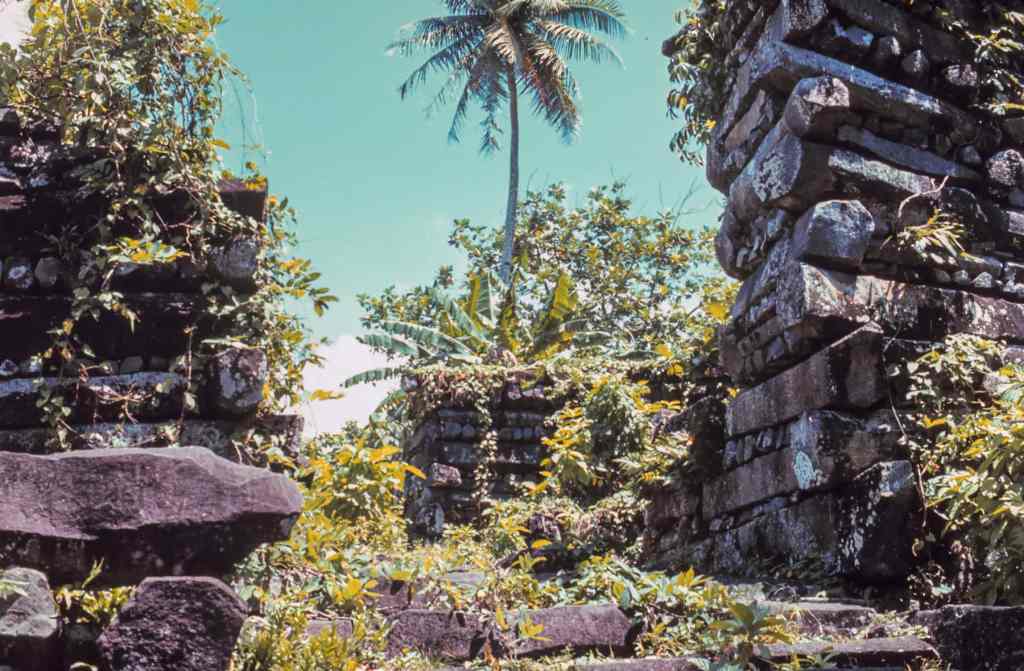
Isokelekel established the Nahnmwarki system that still governs traditional Pohnpeian society today, but he never occupied Nan Madol. The stone city was too associated with the defeated dynasty’s power. Within a generation, the jungle began reclaiming the basalt walls. Mangrove trees split apart carefully balanced stones. High tides washed away the coral fill. What had taken centuries to build began its slow return to the reef.
What had taken centuries to build began its slow return to the reef.
European contact came in 1529 when Spanish navigator Álvaro de Saavedra spotted Pohnpei, but Nan Madol remained largely hidden from Western eyes until the mid-19th century. When American missionaries finally saw the ruins, they refused to believe Pacific Islanders could have built something so monumental. Thus began a century of racist theories attributing Nan Madol to everyone from ancient Greeks to the lost tribes of Israel—anything to avoid crediting Micronesian ingenuity.
Sacred Terror: Why Locals Still Fear the Ruins
Modern Pohnpeians approach Nan Madol with deep ambivalence. It’s a source of cultural pride—proof of their ancestors’ engineering genius—but also a place of spiritual danger. Local tradition holds that anyone who spends the night in the ruins will die. This isn’t mere superstition; it’s cultural memory of a place built on suffering. The massive construction project likely required forced labor from across the island. Those basalt columns didn’t fly—they were dragged by human muscle and paid for in human lives.
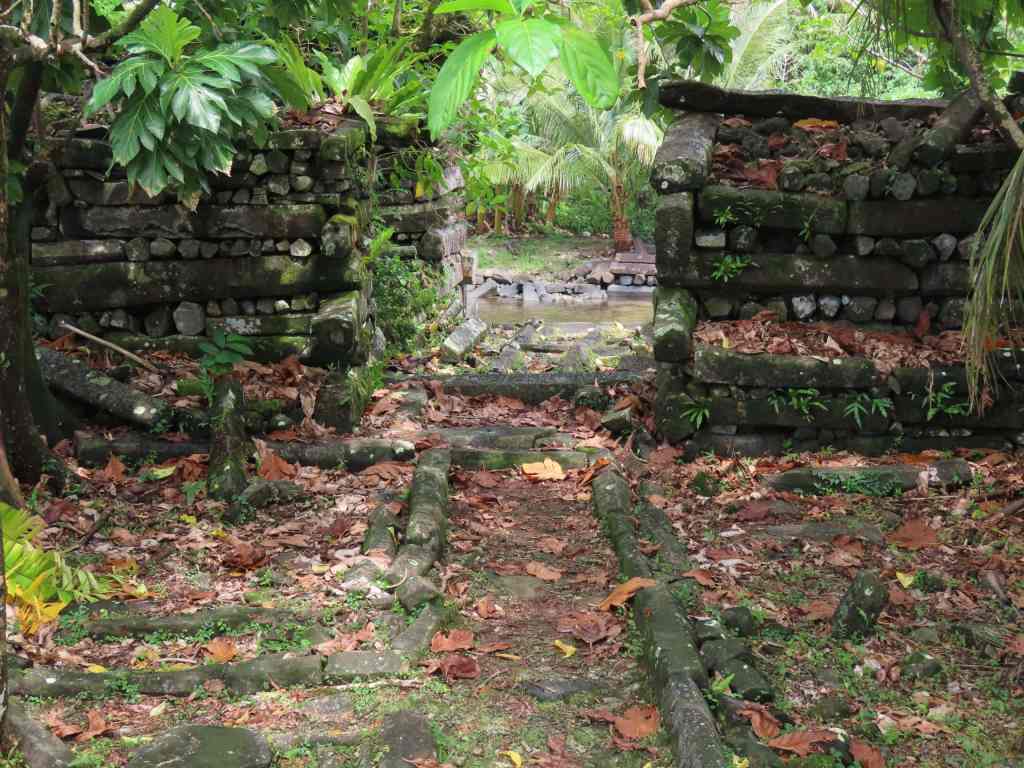
Even today, many local guides will not enter certain areas, particularly the tomb complex of Nandauwas where Saudeleur rulers were interred. They speak of eni—supernatural guardians that protect the site. Western archaeologists dismiss these as folk beliefs, but they work: fear has preserved Nan Madol better than any conservation program. Looters think twice when they believe the stones themselves are watching.
In Their Own Words
“The walls have eyes, the stones have memories. We respect what our ancestors built, but we don’t disturb their sleep.” — Masao Silbanuz, Pohnpeian cultural guide
UNESCO Politics: Protecting the Venice of the Pacific
In 2016, Nan Madol achieved UNESCO World Heritage status—and immediately landed on the endangered list. Rising sea levels threaten to submerge the lower structures within decades. Unchecked mangrove growth splits apart walls that have stood for centuries. But the biggest threat might be good intentions. The Federated States of Micronesia lacks resources for major conservation work, leading to offers of “help” from larger nations with their own agendas.
Japan has funded some restoration work, carefully documenting each stone’s position before reinforcing foundations. But proposals for concrete reinforcement or tourist walkways have met fierce resistance from traditional leaders. They argue that Nan Madol’s power comes partly from its fragility—from the reminder that even the mightiest dynasties eventually return to the reef. Over-restoration would turn a living archaeological site into a theme park.
Climate change adds urgency to these debates. Storm surges that once happened every decade now strike annually. Each typhoon shifts the basalt columns slightly, and there may come a storm that finally topples what the Saudeleurs built. Some propose drastic measures: seawalls, drainage systems, even relocating the most important structures. Others argue for documentation and digital preservation, accepting that Nan Madol will eventually return to the sea.
Echoes Across the Pacific: Nan Madol’s Lost Connections
Nan Madol doesn’t exist in isolation. Similar megalithic structures dot the Pacific, from the stone money of Yap to the moai of Easter Island. The basalt city represents the apex of a stone-building tradition that flourished across Oceania. But unlike Easter Island, where resource depletion led to societal collapse, Nan Madol was abandoned for political reasons while Pohnpei itself continued to thrive.
Recent archaeological work suggests connections to the broader Lapita cultural complex that colonized much of the Pacific. Pottery shards and obsidian found at Nan Madol indicate trade networks linking Pohnpei to the wider Pacific exchange systems that flourished in the centuries after the older Lapita tradition had ended. The city wasn’t an isolated experiment but part of a Pacific-wide tradition of monumental architecture adapted to local materials and conditions.

Perhaps most intriguingly, the oral traditions of building Nan Madol share elements with myths from across Polynesia and Micronesia. The flying stones, the sorcerer-architects, the divine rulers—these appear in various forms from Tahiti to Tonga. Either these cultures shared engineering techniques so advanced they seemed like magic, or they shared stories to explain monuments whose construction methods were forgotten. Either way, Nan Madol stands as testimony to Pacific Islander achievement centuries before European contact.
Nan Madol stands as testimony to Pacific Islander achievement centuries before European contact.
Visiting the Impossible: A Modern Pilgrimage
Today, reaching Nan Madol requires commitment. No cruise ships dock at Pohnpei. The ruins lie 45 minutes by boat from Kolonia, the island’s main town, through mangrove channels that haven’t changed since the Saudeleur era. Local guides—often descendants of the original builders—navigate by memory, reading currents and tides like their ancestors did.
The approach by water is essential to understanding Nan Madol. You don’t walk up to these ruins; you float toward them, watching basalt walls emerge from the jungle like the ribs of sleeping giants. At high tide, your boat glides through the ancient canals. At low tide, you walk on exposed coral, careful not to slip on surfaces made slick by centuries of algae. Either way, you experience the city as intended: as a place between land and sea, between human ambition and natural power.

Most visitors spend three to four hours exploring the accessible islets. Pahnkedira offers the best preserved walls. Nandauwas provides the most imposing architecture. But the real experience comes from sitting quietly and listening: to water lapping against stone, to fruit bats chittering in the canopy, to the whisper of wind through basalt corridors. This is when you understand why locals consider the place haunted. There’s a presence here that has nothing to do with ghosts and everything to do with the weight of human achievement.
Frequently Asked Questions
How did ancient builders transport 50-ton stones across the ocean?
This remains Nan Madol’s greatest mystery. The basalt was quarried at Sokehs on Pohnpei’s northwest side, requiring transport across the island or around it by sea. Theories include massive bamboo rafts, coordinated fleets of outrigger canoes during calm seasons, or even deliberate flooding of temporary canals cut across the island. No method has been successfully replicated with stones of comparable size. The oral tradition of flying stones might metaphorically describe a transport method so efficient it seemed magical to later generations who had lost the knowledge.
Is Nan Madol really cursed?
The belief that spending a night in Nan Madol brings death serves as an effective cultural protection mechanism. While skeptics point to natural explanations—dangerous tides, unstable ruins, tropical diseases—the prohibition reflects deeper cultural memory. Nan Madol was built by a dynasty remembered for cruelty, likely using forced labor. The curse may be a way of acknowledging and respecting the suffering embedded in those stones. Whether supernatural or psychological, the fear is real enough that even police officers have refused nighttime patrols of the site.
Why was Nan Madol abandoned so completely?
Unlike gradual abandonments seen elsewhere, Nan Madol’s desertion was sudden and deliberate. When Isokelekel overthrew the Saudeleur Dynasty around 1450, he chose not to occupy their capital, viewing it as spiritually contaminated by the previous rulers’ tyranny. The new leadership system he established was intentionally decentralized, preventing future concentration of power. Additionally, maintaining a city on artificial islands required constant imports of food and water—a system that collapsed without the Saudeleurs’ tribute networks. Within a generation, the jungle had reclaimed what politics had abandoned.
What’s the connection between Nan Madol and Lemuria?
In the early 20th century, occultists and pseudoarchaeologists linked Nan Madol to the mythical lost continent of Lemuria or Mu, claiming it was either a colony or the last remnant of an advanced prehistoric civilization. These theories, promoted by writers like James Churchward, have no archaeological support and are rooted in racist assumptions that Pacific Islanders couldn’t create monumental architecture independently. Modern scholarship recognizes Nan Madol as an indigenous Micronesian achievement, built by the ancestors of today’s Pohnpeians using sophisticated but entirely human engineering techniques.
Can Nan Madol survive climate change?
Sea level rise poses an existential threat to Nan Madol. The site already floods at high tide, and projections suggest many lower structures will be permanently submerged by 2100. More immediate dangers come from intensifying storms that shift the carefully balanced basalt columns. Conservation efforts focus on documentation and stabilization rather than prevention—accepting that the city built on a reef will eventually return to the sea. The question isn’t whether Nan Madol will survive in its current form, but how much knowledge we can preserve before the Pacific reclaims its greatest archaeological mystery.
Standing among Nan Madol’s basalt columns as the tide turns, you’re confronted with a fundamental question about human ambition: What drives people to build the impossible? The Saudeleurs created their stone city not because it was practical, but because it was audacious—a declaration that human will could reshape the very reef itself. Today, as rising seas threaten to reclaim what took centuries to build, Nan Madol reminds us that all monuments are temporary negotiations with nature. The mystery isn’t how they built it, but why we’re still compelled to try.